

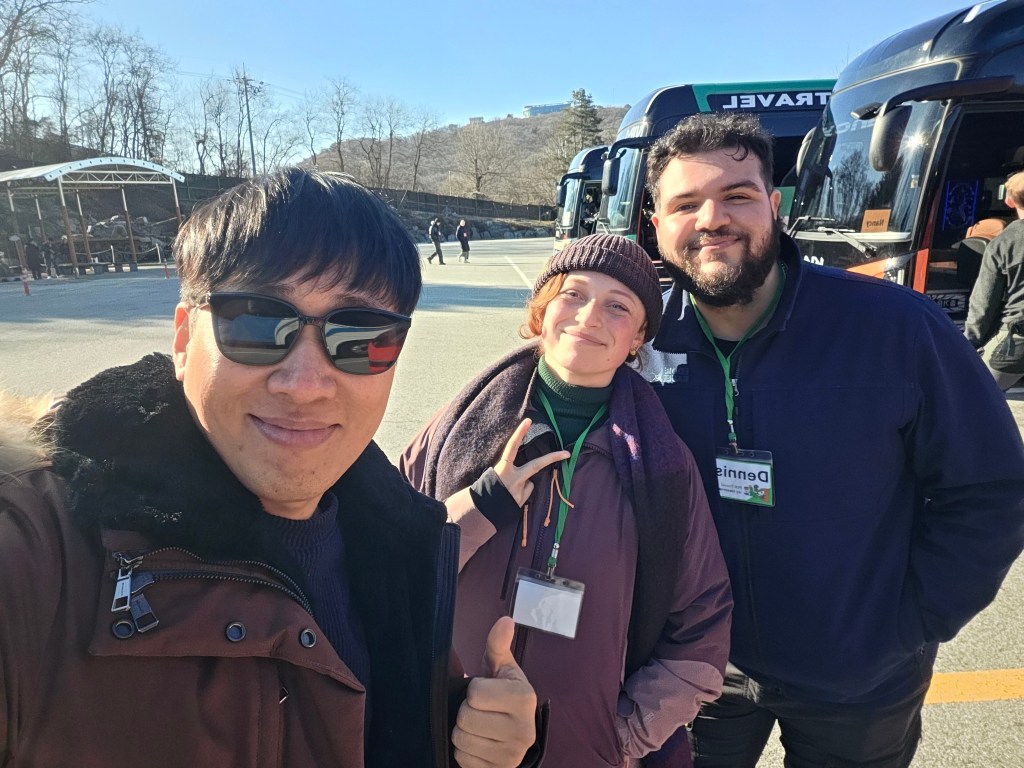
One of the most profound privileges of being a DMZ tour guide is witnessing how history, politics, and humanity collide in the most unexpected ways. Every day, I meet people from all corners of the globe, each carrying their own perspectives, scars, and stories. But recently, I had an encounter that left a deep, lingering impression on me.
On one of my tours, I guided a young couple. One was from Israel, and the other was Palestinian.
At a time when violence, tragedy, and decades of bitter conflict dominate the headlines surrounding their homeland, standing between the two of them felt surreal. By the rigid logic of borders, flags, and inherited animosity, their worlds are supposed to be divided by an insurmountable wall. Yet there they were, side by side, holding hands, listening quietly as we walked along the edge of the world’s most heavily fortified border.
Standing with them at the DMZ—a place defined by division, barbed wire, and the unresolved pain of a peninsula split in two—the irony and the beauty of the moment were overwhelming. Here in Korea, two nations sharing the same blood, language, and ancestral heritage have spent over seven decades viewing each other through rifle scopes, separated by an impenetrable line. We often tell ourselves that some divisions are simply too deep to heal, that history’s momentum is impossible to reverse.
Yet, right in front of me stood living proof of the opposite.
They did not ignore where they came from, nor did they pretend the pain of their homelands didn’t exist. But in a world constantly demanding that they choose hate, they chose each other. Where politics insisted on an enemy, they found shared humanity and love.
Watching them look out toward North Korea, I felt a quiet sense of hope. The DMZ is often seen as a monument to tragedy and unfinished business, but moments like this remind me that borders are drawn by governments, while empathy is chosen by individuals. If two people from opposite sides of one of the world’s most agonizing conflicts can cross that emotional chasm, perhaps the divides we face—both in Korea and across the globe—are not permanent after all.
I am deeply honored to have met them and to have shared this space with them. I hope their courage and love remain a quiet light against the darkness of conflict, and I hope that one day, the walls dividing our world—both physical and in our hearts—will give way to peace.


Leave a Reply